
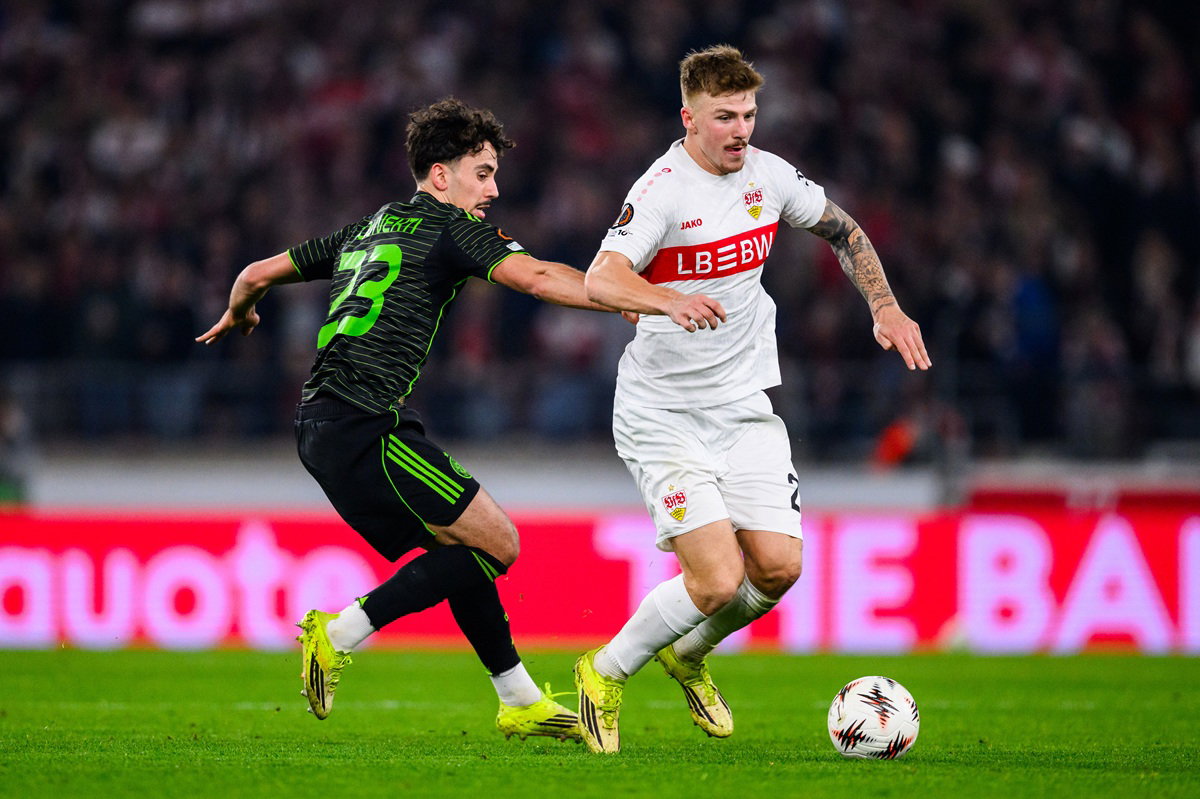
Arsenal are among several teams who are “interested” in signing Stuttgart centre-back Finn Jeltsch, according to reports.
Jurgen Klopp included the 20-year-old in Germany’s squad for their Nations League fixtures against the Netherlands, Greece (x2) and Serbia.
Jeltsch has yet to receive a cap at senior level, but he was on the bench for the 2-0 win over Serbia on Thursday evening, having not made the matchday squad for the previous two games.
Tuttomercatoweb claim that the Gunners, Liverpool and Bayern Munich have been watching the defender, following on from reports in Germany that have mentioned Inter Milan and Barcelona as potential suitors.
What do fans need to know about Jeltsch?
The German came through Nuremberg’s youth system, going on to make his first-team debut against Kaiserslautern in February 2025.
Jeltsch only made 33 appearances before Stuttgart snapped him up for €9.5m almost exactly a year later. He played several games at right-back early on during his time with the Bundesliga side, but he quickly established himself as a regular starter in the middle of defence.
Last season, he started 29 times in all competitions, helping Stuttgart reach the final of the German Cup, the last 16 of the Europa League, and a 4th place finish in the league.
Do Arsenal need another centre-half?
Manager Mikel Arteta can already call upon William Saliba, Gabriel, Ezri Konsa and Cristian Mosquera as options, while the likes of Jurrien Timber, Ben White, Riccardo Calafiori and Piero Hincapie are also capable of playing in central areas if required.
For that reason, it would be a surprise if Jentsch is a top target. The fact that he has so much experience already despite his young age means that club scouts may be keeping an eye on him for the future, but there is currently no room for another centre-back in the first-team squad.
PakarPBN
A Private Blog Network (PBN) is a collection of websites that are controlled by a single individual or organization and used primarily to build backlinks to a “money site” in order to influence its ranking in search engines such as Google. The core idea behind a PBN is based on the importance of backlinks in Google’s ranking algorithm. Since Google views backlinks as signals of authority and trust, some website owners attempt to artificially create these signals through a controlled network of sites.
In a typical PBN setup, the owner acquires expired or aged domains that already have existing authority, backlinks, and history. These domains are rebuilt with new content and hosted separately, often using different IP addresses, hosting providers, themes, and ownership details to make them appear unrelated. Within the content published on these sites, links are strategically placed that point to the main website the owner wants to rank higher. By doing this, the owner attempts to pass link equity (also known as “link juice”) from the PBN sites to the target website.
The purpose of a PBN is to give the impression that the target website is naturally earning links from multiple independent sources. If done effectively, this can temporarily improve keyword rankings, increase organic visibility, and drive more traffic from search results.